The less often someone shows up at church, the less likely they may be to share the opinions of those who frequent the pews.
Americans who occasionally attend church don’t often fit neatly with other groups. They wouldn’t be classified as religiously unaffiliated but are often less likely to embrace the theological positions of the more devout with whom they regularly, if less frequently, gather with on Sunday mornings.
A Lifeway Research study and additional analysis of the State of Theology study highlight the theological perspectives of infrequent churchgoers, those who attend a Protestant church once or twice a month. Comparing them to those who attend worship services at their churches more frequently reveals significant differences.
“It has become popular in some circles to downplay the importance of church attendance either because another measure may be more predictive of spiritual growth or because for too long it was one of the only spiritual metrics,” said Scott McConnell, executive director of Lifeway Research.
“Local congregations are called to disciple the believers God has given them. This analysis comparing frequent and infrequent church attendees shows church attendance can lead to greater discipleship and is worth encouraging.”
Church contrasts
Unsurprisingly, infrequent church attendees have a different perspective on the value of regularly gathering with other Christians at a local church.
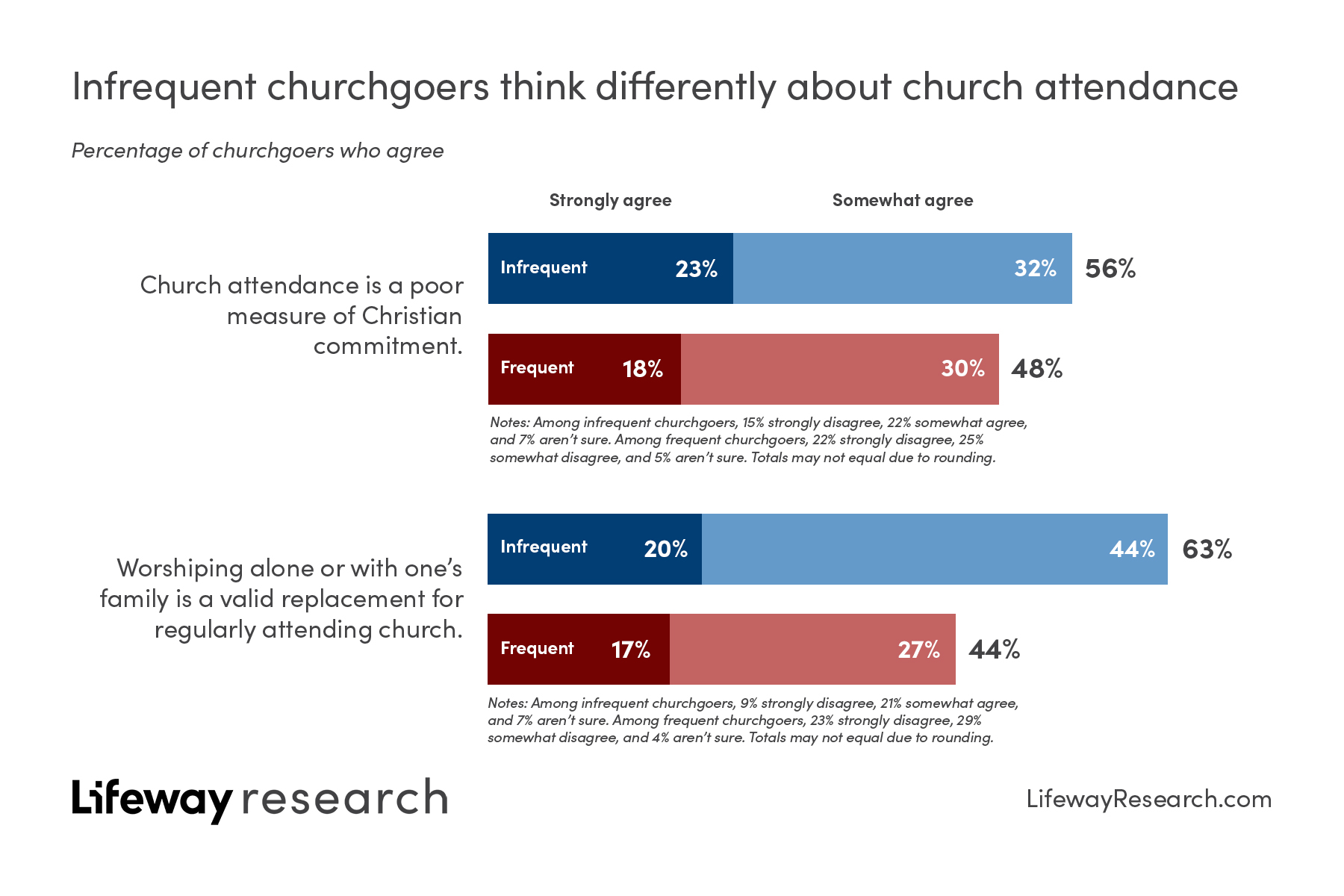
Most (56%) infrequent churchgoers say church attendance is a poor measure of Christian commitment, including 23% who strongly agree. By comparison, 48% of more regularly attending churchgoers agree, with 18% strongly agreeing.
Additionally, those who attend once or twice a month are far more likely than those who attend more to say worshiping alone or with one’s family is a valid replacement for attending church (63% v. 44%).
While more than 9 in 10 infrequent and regular churchgoers both agree the Bible instructs believers to follow Jesus Christ together. Those attending once or twice a month are far less likely to strongly agree (54% v. 72%).
While they attend less often, infrequent churchgoers are also less likely to see the need to become a church member. Almost half of those attending a couple of times a month (46%) agree every Christian has an obligation to join a local church, while 61% of frequent attenders agree.
As they are more sporadic in their attendance, infrequent churchgoers often don’t feel as plugged into the life of their church or connected with other believers.
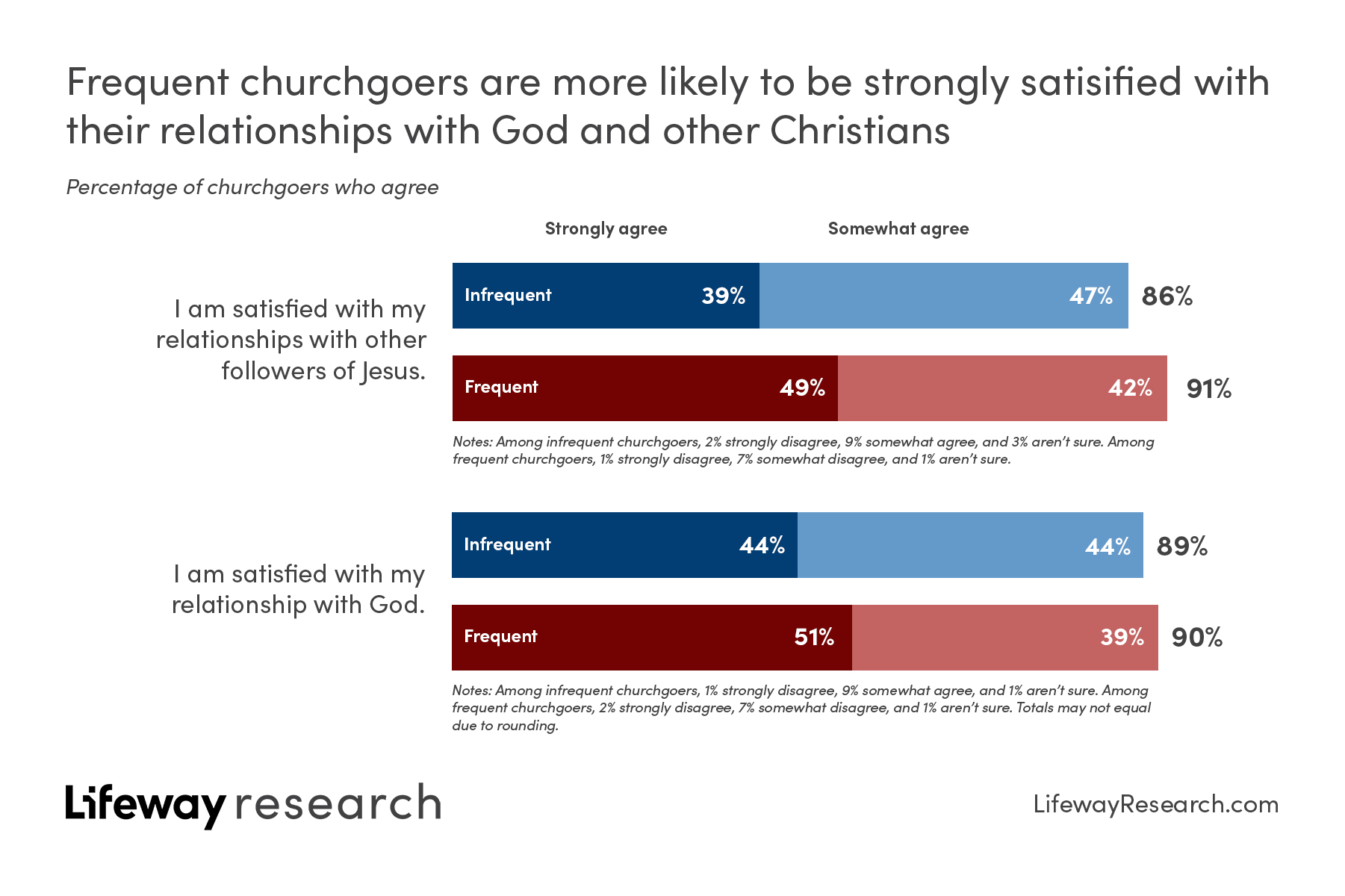
Close to 9 in 10 of both frequent and infrequent attendees are satisfied with their relationship with other followers of Jesus. Among frequent churchgoers, however, half (49%) strongly agree, while 39% of infrequent attendees share this level of agreement.
Around half of infrequent attendees (51%) say people reach out to them to let them know they were missed when they don’t attend, compared to almost 3 in 4 of those who attend more frequently (73%).
“There is a relationship between the quantity of interactions among churchgoers and the quality of those relationships,” said McConnell. “Understanding God’s design for how believers follow Him—together—also corresponds with those who are actually together for worship more often. Ultimately, attendance comes down to personal motivation, and infrequent attendees need to hear that this is God’s desire and other attendees desire their presence.”
Divine divergences
On the surface, infrequent churchgoers closely resemble those who attend more often in their thinking on theological topics. However, the strength of their opinions indicates real distinctions.
Around 9 in 10 infrequent and frequent churchgoers say they are satisfied with their relationship with God, but infrequent attendees are less likely than frequent to strongly agree (44% v. 51%).
Those who attend once or twice a month are less likely than those who attend more often to strongly agree the biblical accounts of Jesus’ bodily resurrection are completely accurate (64% v. 85%). They are also more likely to agree Jesus was a great teacher but not God (51% v. 28%), the Holy Spirit is a force but not a personal being (64% v. 51%) and God accepts the worship of all religions (63% v. 47%).
Infrequent attenders are more likely to say everyone sins a little but most people are good by nature (70% v. 54%) and everyone is born innocent in the eyes of God (80% v. 65%), while they are less likely to agree that even the smallest sin deserves eternal damnation (31% v. 45%).
Biblical imbalance
Those who attend church less often are less likely to recognize the truthfulness and authority of Scripture.
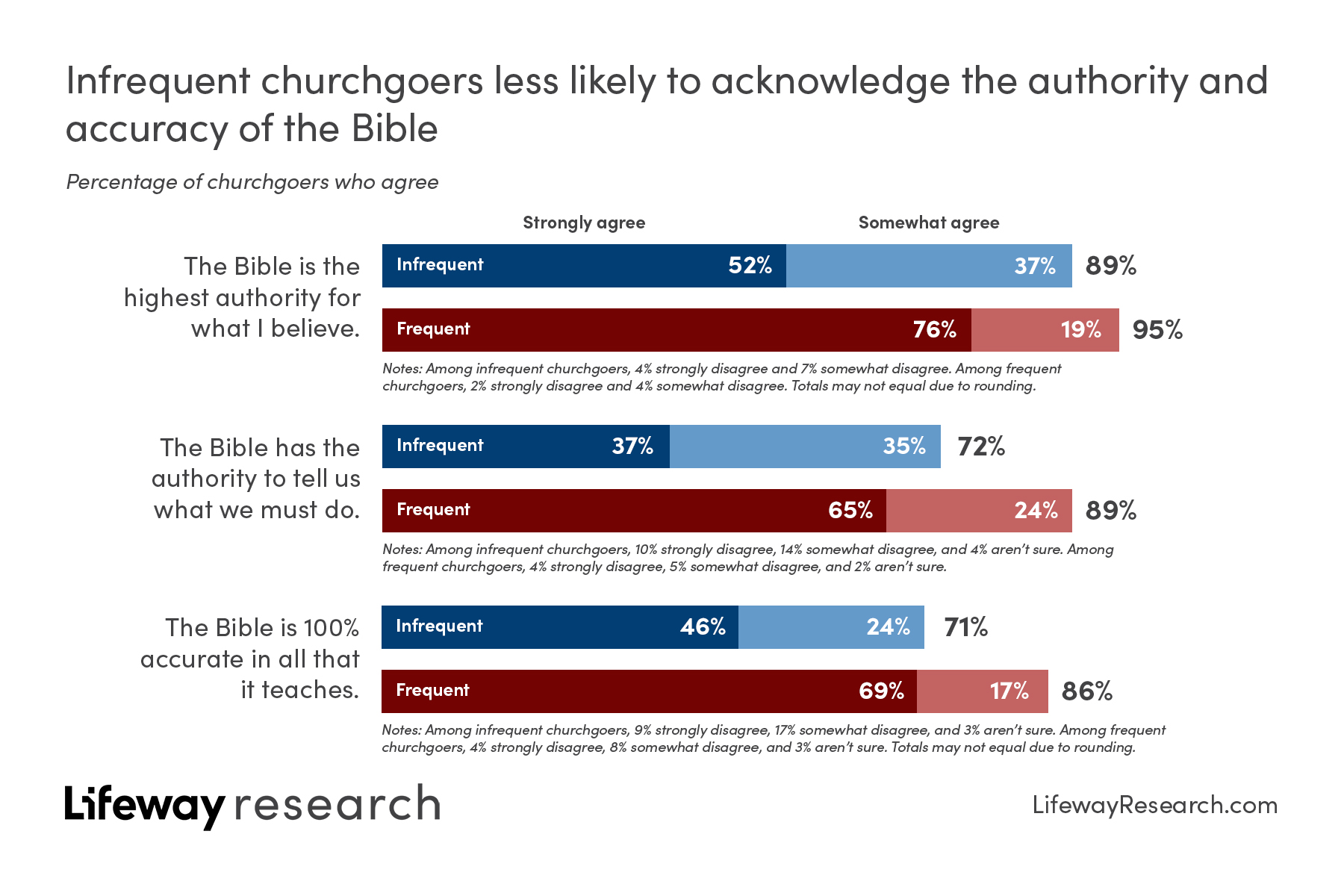
Compared to those who attend more often, infrequent churchgoers are less likely to strongly believe the Bible is the highest authority for what they believe (52% v. 76%), is 100% accurate in all that it teaches (46% v. 69%) or has the authority to tell us what we must do (37% v. 65%).
They are also less likely to strongly disagree that the Bible, like all sacred writings, contains helpful accounts of ancient myths but is not literally true (37% v. 64%).
“Some of the widest differences between infrequent and weekly church attendees are in the strength of responses to the accuracy and authority of Scripture,” said McConnell. “Worship services typically include proclamation of the Word of God and uniting in songs and readings drawn from the Word of God. So one way to encourage attendance is explaining the Bible’s importance and encouraging its prioritization.”
Cultural inconsistencies
Differences in opinions between those who attend worship services infrequently and those who attend frequently extend beyond the church walls. Church attendance also impacts perspectives on cultural issues.
Infrequent attendees are less likely to strongly agree God created marriage to be between one man and one woman (68% v. 84%).
Mofre in the full report below.
For more information, view the complete report and visit LifewayResearch.com.