Even with wide differences across congregations, most attendees are content with their church’s worship style.
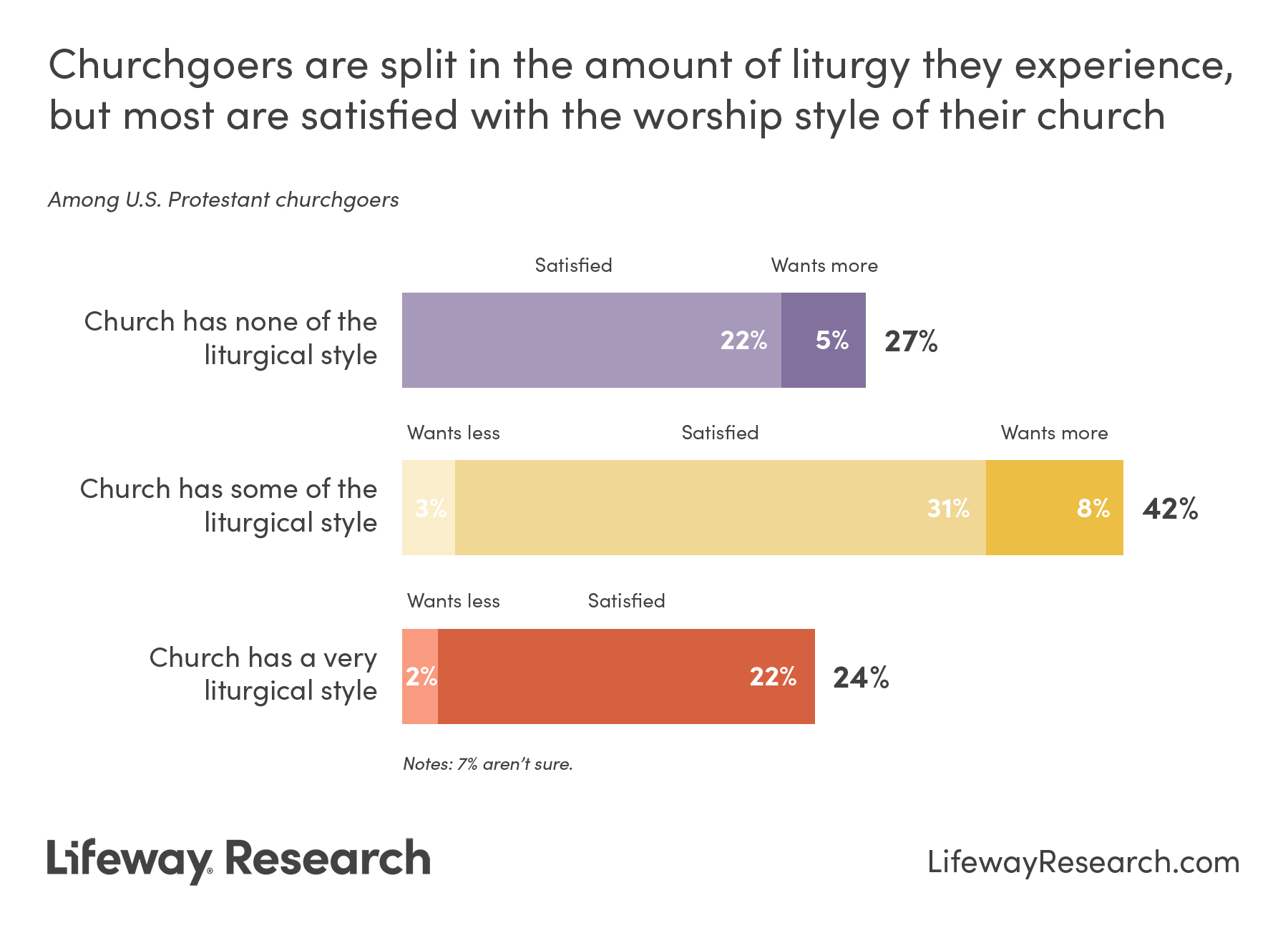
Protestant churches in the U.S. vary significantly in how they structure their services, particularly elements like set prayers, readings and formal patterns. Despite those differences, Lifeway Research finds 3 in 4 Protestant churchgoers (75%) say they are fine with the current amount of liturgical style in their church, while 13% would like more, 5% would prefer less and 7% are unsure.
“Both individual churches and branches of Protestant Christianity have different amounts of liturgy in their history. It’s reassuring to see the vast majority of churchgoers are comfortable with that,” said Scott McConnell, executive director of Lifeway Research. “Whether it’s what they grew up with or what they’ve experienced in their current church, most are satisfied with their congregation’s worship traditions.”
Worship styles
When asked about their congregation’s worship style, Protestant churchgoers report a wide range of experiences. Around 1 in 4 Protestant churchgoers (24%) say their church has a very liturgical style. The largest group (42%) says their church has some liturgical elements, while 27% say their church has none of the liturgical style and 7% are unsure.
Even with those differences, most churchgoers (75%) are satisfied with their current worship style. This group includes 22% who attend churches with no liturgical style, 22% who attend very liturgical churches and 31% who attend churches with some liturgical elements.
“Whether a church uses responsive readings and creeds or a more organic style of worship, those different expressions share the same goal—helping people acknowledge God’s presence and worship Him together. When churches are moving in that same direction, a variety of worship styles can be effective,” said McConnell.
Relatively few churchgoers want their congregations to make changes. Around 13% would prefer more liturgical elements in worship, including 8% who attend churches with some practices and 5% whose churches have none. Meanwhile, 5% would like less liturgy, including 3% at churches with some liturgical elements and 2% at very liturgical churches.
Similarly, pastors have felt an ease of tensions of worship preferences. A 2019 Lifeway Research study found only 15% of U.S. Protestant pastors said navigating varying preferences was the biggest challenge they faced with music in their congregation.
Age gap
Generational differences emerge both in the churches people attend and in how they feel about their worship services. Older churchgoers are more likely to attend liturgical churches and be satisfied with the worship style, while younger churchgoers are more likely to want their church to include more liturgy. Three in 10 of those 65 and older (29%) say their church has a very liturgical style. In comparison, only 15% of churchgoers 18-29 describe their church that way.
Those differences are also reflected in contentment levels. Older churchgoers are more likely to be content with the amount of liturgy in their worship. Eight in 10 of those 50-64 (80%) say they are fine with the amount of liturgy in their church, along with 77% of those 65 and older. Those ages 18-29 and 30-49 are less likely to report they are satisfied (69%).
If they could make changes, younger churchgoers are more likely to want additional liturgical elements in their services. Around 1 in 5 of those ages 18-29 (18%) and 30-49 (19%) would like more structure, while 9% of those 50 and older say the same.
“Many younger churchgoers are curious and eager to grow in their faith, but they may still be learning how the larger story of Scripture fits together. Liturgical elements such as creeds and other regular practices can serve as helpful reminders of biblical truths and provide structure that guides believers through worship,” said McConnell.
Worship by denomination
The presence of liturgical elements often reflects theological beliefs and denominational traditions.
Churchgoers with evangelical beliefs are more likely to say their church has none of the liturgical style than those without evangelical beliefs (34% v. 19%).
Almost half of non-denominational churchgoers (45%) say their church has no liturgical style. More than a quarter of Baptists (27%) say the same. By contrast, most Lutherans (56%) and nearly 2 in 5 Presbyterian/Reformed (38%) churchgoers say their church is very liturgical.
Presbyterian/Reformed churchgoers (22%) are also among the most likely to say they would like more liturgical elements in their services. By comparison, Lutherans (10%), non-denominational churchgoers (9%) and Methodists (8%) are less likely to express a desire for additional liturgy.
Non-denominational churchgoers are among the most likely to be satisfied with their current level of liturgical worship, with 79% saying they are fine with their church's approach, compared to 71% of Baptists.
Additional factors
Several other demographic and church characteristics are associated with differences in the use of liturgy and satisfaction with worship styles.
Men (26%) are more likely than women (21%) to say their church is very liturgical. African American churchgoers (19%) are more likely than white (11%) and Hispanic churchgoers (10%) to say they would like more liturgical elements.
More formal education for a churchgoer tends to mean more satisfaction with their church’s worship service approach. Those with a bachelor's degree or graduate degree (78%) are more likely than those with a high school education or less (70%) to say they are satisfied with their church’s current amount of liturgical style.
Church size also plays a role. Most churchgoers at churches with 500 or more attendees (51%) say their congregation doesn’t include any liturgical style. Those attendees are also among the most likely to be satisfied with their church's liturgy approach, with 80% saying they are fine with the current amount.
For more information, view the complete report and visit LifewayResearch.com.